
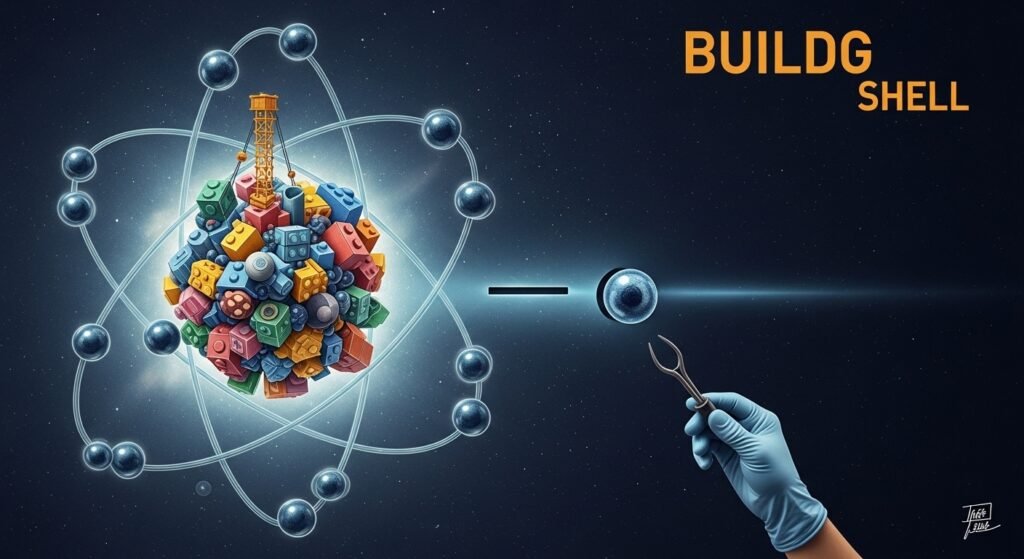
Introduction: The Fascination Behind Build an Atom
The idea to Build an Atom may sound like something out of a science fiction movie, but in reality, it is a fundamental concept in chemistry and physics that scientists and students explore every day. From classrooms to advanced laboratories, the concept of how atoms are formed has become a central part of understanding matter. When you attempt to Build an Atom, you are essentially learning how the smallest units of matter come together to create everything around us.
Atoms are the building blocks of the universe, and understanding how to construct them conceptually helps unlock deeper knowledge about chemical reactions, energy, and even life itself. While physically building an atom in the traditional sense is not possible for humans, modern science provides tools, simulations, and experiments that allow us to recreate atomic structures in a virtual or theoretical way. The answer to whether you can truly Build an Atom is more surprising than you might think.
What Does It Mean to Build an Atom
To Build an Atom means to understand and assemble its three main subatomic particles: protons, neutrons, and electrons. Each of these particles plays a unique role in determining the identity and behavior of the atom.
Protons carry a positive charge and are located in the nucleus. Neutrons have no charge and also reside in the nucleus, adding stability. Electrons carry a negative charge and orbit the nucleus in specific energy levels. When these particles come together in the right combination, an atom is formed.
Structure of an Atom
| Particle | Charge | Location | Function |
|---|---|---|---|
| Proton | Positive | Nucleus | Determines element |
| Neutron | Neutral | Nucleus | Adds stability |
| Electron | Negative | Orbitals | Controls bonding |
This simple structure is the foundation of all matter. By adjusting the number of protons, you can change the element, while altering neutrons creates isotopes. Changing electrons affects how atoms interact with each other.
The Science Behind Build an Atom
When scientists talk about Build an Atom, they are usually referring to theoretical models and simulations rather than physical construction. This is because atoms are incredibly small—far beyond what we can see or manipulate directly with our hands.
However, in laboratories, scientists use particle accelerators to study subatomic particles. These machines allow researchers to observe how particles behave and interact. Although they are not literally assembling atoms piece by piece, they are gaining insights into how atoms naturally form.
Key Scientific Concepts
| Concept | Explanation |
|---|---|
| Atomic Number | Number of protons in the nucleus |
| Mass Number | Protons + neutrons |
| Energy Levels | Regions where electrons exist |
| Atomic Stability | Balance between forces in nucleus |
These concepts are essential when trying to understand how to Build an Atom in a scientific sense.
Can You Physically Build an Atom
The honest answer is no—you cannot physically Build an Atom like assembling a machine. Atoms form naturally under extreme conditions, such as inside stars or during nuclear reactions. The forces required to combine subatomic particles are incredibly strong and cannot be replicated easily outside of specialized environments.
However, scientists can manipulate atoms using advanced technology. For example, in nanotechnology, researchers can move individual atoms to create new materials. This is not the same as building an atom from scratch, but it shows how far science has come in controlling matter at the atomic level.
How Simulations Help You Build an Atom
One of the most effective ways to learn how to Build an Atom is through simulations. Educational tools allow students to add protons, neutrons, and electrons to see how atoms change in real time. These simulations make abstract concepts easier to understand.
For example, when you add one proton, you create hydrogen. Add another, and you get helium. By continuing this process, you can explore the entire periodic table.
Simulation Learning Table
| Action | Result |
|---|---|
| Add Proton | Changes element |
| Add Neutron | Creates isotope |
| Add Electron | Affects charge |
| Remove Electron | Creates ion |
These interactive tools provide a hands-on way to understand atomic structure without needing a laboratory.
Why Build an Atom Matters in Education
Learning to Build an Atom is a crucial step in science education. It helps students understand the basic principles of chemistry and physics. Without this knowledge, it would be difficult to grasp more advanced topics like chemical reactions, molecular bonding, and energy transfer.
By studying atomic structure, students develop critical thinking skills and gain a deeper appreciation for how the world works. The concept also connects to real-world applications, including medicine, engineering, and environmental science.
The Role of Build an Atom in Modern Science
In modern science, the concept to Build an Atom goes beyond education. Researchers use atomic models to develop new technologies, including semiconductors, medical imaging devices, and renewable energy solutions.
Understanding atomic behavior allows scientists to predict how materials will react under different conditions. This knowledge is essential for innovation and technological advancement.
Common Misconceptions About Build an Atom
Many people believe that scientists can easily Build an Atom in a lab, but this is not true. The process is far more complex and requires conditions that are difficult to achieve.
Another misconception is that atoms are static structures. In reality, atoms are dynamic, with electrons constantly moving and interacting with their environment. This movement plays a key role in chemical reactions and energy transfer.
Comparing Natural and Theoretical Build an Atom
| Aspect | Natural Formation | Theoretical Building |
|---|---|---|
| Location | Stars, nuclear reactions | Classrooms, simulations |
| Process | High energy fusion | Conceptual learning |
| Control | Uncontrolled | Fully controlled |
| Purpose | Creation of elements | Understanding structure |
This comparison highlights the difference between how atoms form naturally and how we study them.
The Future of Build an Atom Technology
As technology advances, the concept to Build an Atom may become more practical in certain contexts. Scientists are already exploring ways to manipulate atomic structures to create new materials with unique properties.
Quantum computing, for example, relies on precise control of atomic and subatomic particles. While we may never physically build atoms from scratch, our ability to control and manipulate them continues to improve.
Conclusion: The Surprising Truth About Build an Atom
So, can you really Build an Atom? The answer is both yes and no. While it is not possible to physically assemble an atom like a machine, science has provided powerful tools to simulate, study, and manipulate atomic structures in incredible ways.
The surprising truth is that understanding how to Build an Atom is less about construction and more about comprehension. By learning how atoms work, we gain insight into the very foundation of the universe. From education to advanced research, this concept continues to shape our understanding of science and technology.
In the end, the ability to Build an Atom lies not in our hands, but in our knowledge—and that is what makes it truly remarkable.