
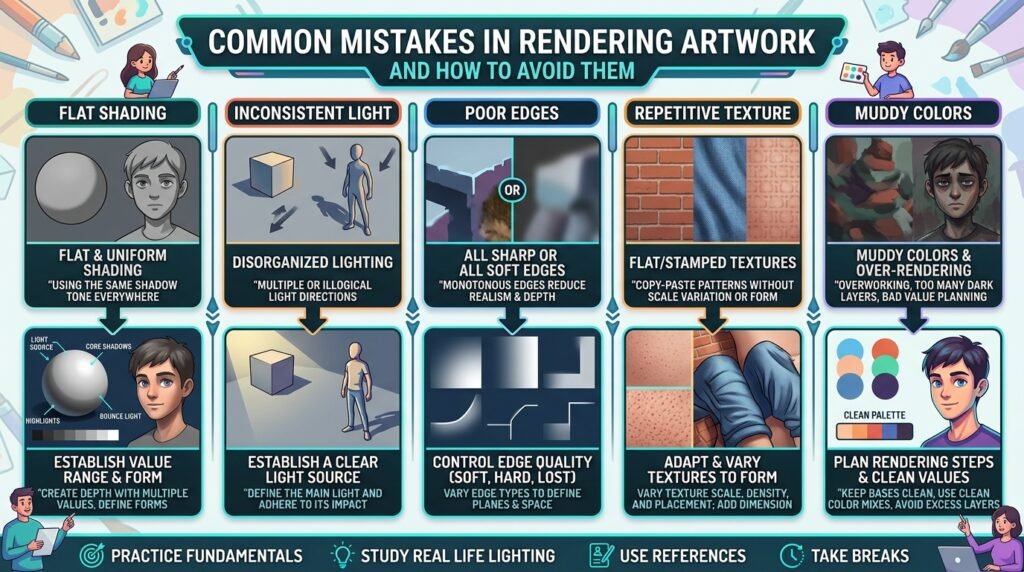
Rendering Artwork is one of the most important stages in the creative process because it transforms rough concepts into visually polished pieces. Whether working in digital illustration, 3D design, animation, or traditional painting, artists rely on rendering techniques to add realism, depth, texture, and emotion to their creations. However, many beginners and even experienced artists struggle with recurring mistakes that reduce the overall quality of their work.
A well-rendered piece requires more than technical skill. It demands an understanding of lighting, composition, anatomy, texture, perspective, and color harmony. Small errors can make artwork appear flat, unrealistic, or visually confusing. By identifying these mistakes early and learning how to avoid them, artists can significantly improve the professionalism and impact of their work.
Mastering artistic rendering takes patience, practice, and attention to detail. Understanding common pitfalls is one of the most effective ways to accelerate improvement and build confidence in artistic abilities.
Understanding the Importance of Rendering Artwork
Rendering is the process of refining artwork by adding shadows, highlights, textures, and visual depth. It bridges the gap between a simple sketch and a finished masterpiece.
Artists use rendering techniques to create mood, realism, and dimensionality. Whether the goal is stylized illustration or photorealism, proper rendering helps viewers connect emotionally with the artwork.
| Rendering Element | Purpose | Visual Impact |
|---|---|---|
| Lighting | Defines form | Creates realism |
| Shadows | Adds depth | Enhances dimension |
| Texture | Improves detail | Increases immersion |
| Color Blending | Smooth transitions | Better harmony |
Without proper rendering techniques, artwork may appear unfinished or lack visual clarity.
Poor Understanding of Light Sources in Rendering Artwork
One of the most common mistakes artists make is inconsistent lighting. Lighting determines how viewers perceive form, depth, and atmosphere within an image.
Many beginners place highlights and shadows randomly without considering where the light source originates. This inconsistency creates unrealistic visuals and weakens the overall composition.
To avoid this issue, artists should establish a clear primary light source before rendering begins. Observing real-world lighting conditions can also improve accuracy.
| Lighting Mistake | Result | Solution |
|---|---|---|
| Multiple unclear light directions | Confusing visuals | Define one main light source |
| Overexposed highlights | Loss of detail | Use balanced brightness |
| Flat shading | Lack of depth | Add contrast gradually |
| Ignoring reflected light | Unrealistic surfaces | Study environmental lighting |
Consistent lighting greatly improves the realism and mood of artwork.
Overusing Blending Techniques
Blending can create smooth transitions and polished finishes, but excessive blending often removes texture and visual interest. Artwork may end up looking muddy or overly soft.
Many artists continuously smudge colors until forms lose definition. While smooth rendering can work for certain styles, preserving edges and texture is equally important.
Professional artists balance hard and soft edges strategically to guide viewer attention and create dynamic compositions.
How to Avoid Excessive Blending
- Use textured brushes when possible
- Preserve sharp focal areas
- Blend selectively rather than globally
- Study surface textures in real life
Maintaining variation in texture and edges helps artwork feel more natural and engaging.
Ignoring Proper Anatomy and Proportions
Even beautifully rendered artwork can appear incorrect if anatomy and proportions are inaccurate. This mistake is especially common in character art and figure drawing.
Artists sometimes focus heavily on detail while neglecting structural fundamentals. As a result, characters may look unnatural or distorted despite advanced rendering techniques.
| Anatomical Issue | Visual Problem | Improvement Method |
|---|---|---|
| Incorrect limb length | Unbalanced figures | Study figure proportions |
| Misaligned facial features | Unnatural expressions | Use construction guidelines |
| Poor hand structure | Distracting details | Practice hand sketches |
| Stiff body poses | Lack of realism | Learn gesture drawing |
Strong foundational drawing skills are essential before adding advanced rendering effects.
Weak Color Harmony in Rendering Artwork
Color harmony plays a crucial role in visual storytelling and emotional impact. Poor color choices can make artwork feel chaotic or unpleasant.
Some artists use overly saturated colors everywhere, while others rely on dull palettes that lack contrast. Understanding color relationships helps create balanced compositions.
Tips for Better Color Harmony
| Color Technique | Benefit |
|---|---|
| Complementary colors | Strong contrast |
| Analogous palettes | Smooth transitions |
| Limited palettes | Visual consistency |
| Warm and cool balance | Better atmosphere |
Artists should experiment with color schemes while considering the mood and purpose of the artwork.
Adding Too Much Detail Too Early
A common mistake in Rendering Artwork is focusing on tiny details before establishing major forms and values. This approach often leads to inconsistent compositions and wasted effort.
Successful rendering usually follows a structured workflow. Artists begin with large shapes, establish lighting, and gradually refine smaller elements.
Jumping into details too soon can make it difficult to adjust proportions or composition later in the process.
Recommended Rendering Workflow
| Stage | Main Focus |
|---|---|
| Sketching | Composition and structure |
| Blocking Values | Light and shadow placement |
| Refinement | Form development |
| Detailing | Textures and finishing touches |
Following a logical workflow improves efficiency and visual consistency.
Neglecting Background and Environment
Many artists spend significant time rendering characters or objects while ignoring the background. This imbalance can make artwork feel incomplete.
Backgrounds help establish context, atmosphere, and depth. Even simple environmental elements can dramatically improve composition quality.
A well-rendered environment supports the focal point rather than distracting from it. Artists should consider perspective, lighting, and color harmony throughout the entire scene.
Overcomplicating the Composition
Complex compositions can become visually overwhelming if not carefully organized. Too many focal points or unnecessary details may confuse viewers.
Strong compositions guide the eye naturally through the artwork. Simplicity often creates greater visual impact than excessive complexity.
| Composition Mistake | Effect | Solution |
|---|---|---|
| Too many focal points | Visual confusion | Prioritize one main subject |
| Cluttered backgrounds | Reduced clarity | Simplify supporting elements |
| Poor balance | Awkward layout | Use composition grids |
| Weak contrast | Flat visuals | Improve value variation |
Artists should focus on clarity and storytelling rather than unnecessary complexity.
Misusing Textures in Rendering Artwork
Textures add realism and personality to artwork, but incorrect texture application can appear artificial or repetitive.
Some artists apply identical textures across every surface without considering material differences. Skin, metal, fabric, and wood all reflect light differently and require unique rendering approaches.
Studying real-world materials helps artists understand how textures behave under different lighting conditions.
Common Texture Types
| Material | Rendering Approach |
|---|---|
| Metal | Sharp highlights |
| Fabric | Soft folds and shading |
| Skin | Subtle color variation |
| Wood | Directional grain patterns |
Accurate textures improve immersion and realism significantly.
Failing to Use References
Many beginners avoid using references because they believe it limits creativity. In reality, references help artists understand anatomy, lighting, textures, and perspective more accurately.
Professional artists frequently use reference images to improve realism and efficiency. References provide valuable visual information that memory alone cannot always reproduce accurately.
Using references does not reduce originality. Instead, it strengthens observational skills and technical understanding.
Inconsistent Perspective and Depth
Perspective errors are another major issue in Rendering Artwork. Incorrect perspective can make environments and objects appear distorted or unrealistic.
Artists should understand horizon lines, vanishing points, and spatial relationships before rendering complex scenes.
Perspective Improvement Tips
| Perspective Tool | Purpose |
|---|---|
| Horizon line | Eye-level placement |
| Vanishing points | Object alignment |
| Grid systems | Accurate scaling |
| Atmospheric perspective | Depth creation |
Proper perspective enhances realism and spatial coherence.
Overworking the Artwork
Many artists struggle with knowing when to stop rendering. Constant adjustments can eventually reduce freshness and clarity.
Overworked artwork often loses energy because details become excessive or muddy. Learning when a piece feels complete is an important artistic skill.
Taking breaks during the rendering process allows artists to evaluate their work more objectively.
The Role of Practice in Improving Rendering Artwork
Improvement in artistic rendering comes through consistent practice and experimentation. Every mistake provides learning opportunities that help artists refine their techniques.
Practicing lighting studies, texture exercises, anatomy sketches, and color theory regularly can accelerate artistic growth. Constructive feedback from mentors or art communities also helps identify weaknesses.
| Practice Method | Benefit |
|---|---|
| Daily sketching | Better consistency |
| Lighting studies | Improved realism |
| Texture exercises | Greater material understanding |
| Anatomy practice | Stronger figure accuracy |
Artists who dedicate time to fundamentals usually progress faster than those focusing only on finished pieces.
Modern Digital Tools and Their Impact
Digital art software has transformed rendering techniques by offering advanced brushes, layers, and effects. However, relying too heavily on software shortcuts can create technical dependence.
Artists should use digital tools to support creativity rather than replace fundamental knowledge. Understanding traditional principles remains essential regardless of software capabilities.
Modern tools can improve efficiency, but artistic skill still depends on observation, composition, and technical understanding.
Conclusion
Rendering Artwork is a complex yet rewarding process that brings creative ideas to life through lighting, texture, color, and detail. While mistakes are a natural part of artistic growth, recognizing common problems can help artists improve more effectively.
Issues such as inconsistent lighting, poor anatomy, excessive blending, weak perspective, and overcomplicated compositions often reduce the quality of artwork. By focusing on fundamentals, using references, and practicing consistently, artists can avoid these pitfalls and develop stronger rendering techniques.