
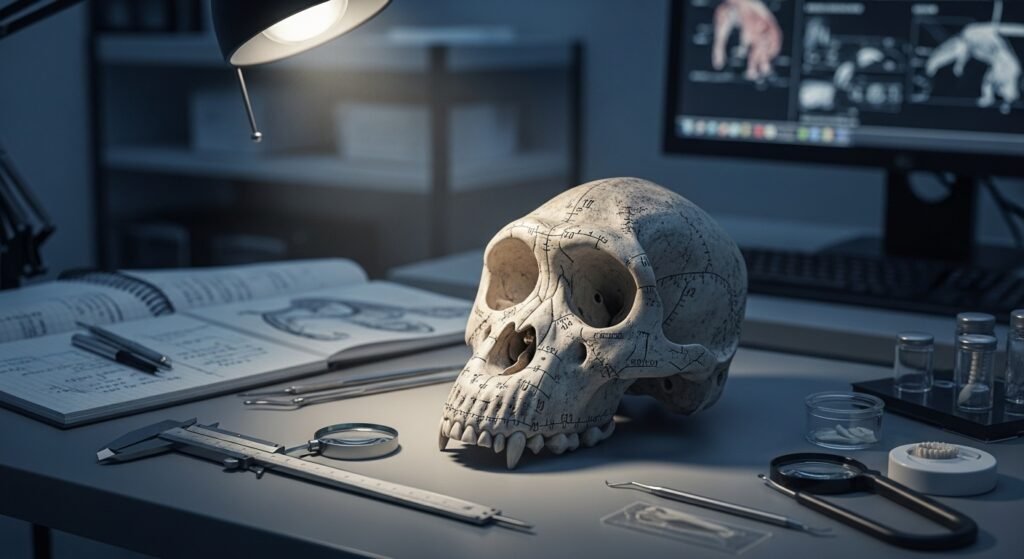
Introduction: The Hidden Story Inside a Chimpanzee Skull
The study of a Chimpanzee Skull has opened a fascinating window into the past, offering scientists valuable clues about evolution, biology, and the connection between humans and primates. For decades, researchers have examined fossil remains and modern specimens to understand how closely related chimpanzees are to humans. What they discovered goes far beyond simple similarities—it reveals deep evolutionary links, surprising structural differences, and insights into how intelligence evolved over time.
A Chimpanzee Skull is not just a bone structure; it is a record of millions of years of adaptation. By analyzing its shape, size, and internal features, scientists have been able to reconstruct evolutionary pathways and better understand how humans developed unique traits such as speech, complex thinking, and upright posture. This article explores those discoveries in detail, shedding light on why the chimpanzee skull continues to be a key focus in scientific research.
Understanding the Structure of a Chimpanzee Skull
The structure of a Chimpanzee Skull is both complex and highly specialized. It consists of various bones that protect the brain, support facial features, and enable functions like chewing and breathing. One of the most noticeable features is the pronounced jaw, which is adapted for a diet that includes fruits, leaves, and occasionally meat.
Scientists have found that the cranial capacity of a chimpanzee is smaller than that of humans, but still large enough to support advanced cognitive functions. The skull also includes strong muscle attachment points, particularly around the jaw and neck, indicating powerful biting and chewing abilities.
Key Structural Features
| Feature | Description | Scientific Insight |
|---|---|---|
| Cranial Capacity | Smaller than humans | Indicates lower brain volume |
| Jaw Structure | Strong and protruding | Adapted for tough foods |
| Brow Ridge | Prominent | Provides structural strength |
| Foramen Magnum | Positioned toward the back | Reflects quadrupedal posture |
These features help scientists understand how chimpanzees function in their natural environment and how their anatomy compares to humans.
What Scientists Learned About Human Evolution
One of the most significant discoveries from studying a Chimpanzee Skull is its role in understanding human evolution. Scientists have found that chimpanzees share approximately 98–99% of their DNA with humans. This close genetic relationship is reflected in the similarities between their skulls.
However, even small differences can lead to major functional changes. For example, the position of the foramen magnum—the hole where the spinal cord enters the skull—is located more centrally in humans, allowing for upright walking. In chimpanzees, it is positioned toward the back, indicating a more forward-leaning posture.
Evolutionary Comparison Table
| Feature | Chimpanzee Skull | Human Skull |
|---|---|---|
| Brain Size | Smaller | Larger |
| Face Shape | Protruding | Flatter |
| Jaw Strength | Strong | Less pronounced |
| Posture Indicator | Quadrupedal | Bipedal |
These differences show how slight changes in skull anatomy played a major role in the development of human traits over millions of years.
Brain Development and Cognitive Abilities
The Chimpanzee Skull has also provided insights into brain development. While chimpanzees have smaller brains compared to humans, their brain structure is still highly advanced. Scientists have discovered that certain regions of the chimpanzee brain are responsible for problem-solving, tool use, and social behavior.
Interestingly, the skull reveals that chimpanzees have a well-developed frontal lobe, although not as large as in humans. This area is associated with decision-making and planning. By studying the internal shape of the skull, researchers can estimate how these brain regions evolved over time.
Another key discovery is that brain growth patterns differ between humans and chimpanzees. Human brains continue to grow for a longer period during childhood, allowing for more complex learning and development. In contrast, chimpanzee brain growth stabilizes earlier, which limits cognitive expansion compared to humans.
Diet and Lifestyle Insights from the Chimpanzee Skull
The shape and structure of a Chimpanzee Skull also provide clues about diet and lifestyle. The large jaw and strong teeth indicate a diet that requires significant chewing القوة. Scientists have observed wear patterns on teeth that suggest chimpanzees consume a variety of foods, including fruits, nuts, and fibrous plants.
The skull also reveals the presence of large chewing muscles, which are attached to the sides and top of the skull. These muscles allow chimpanzees to process tough foods efficiently. In contrast, humans have smaller jaws and weaker chewing muscles due to dietary changes over time, including the use of tools and cooking.
Diet Comparison Table
| Aspect | Chimpanzees | Humans |
|---|---|---|
| Primary Diet | Fruits, leaves | Cooked and processed food |
| Jaw Strength | High | Moderate |
| Tooth Wear | Heavy | Less severe |
| Food Processing | Natural chewing | Tools and cooking |
These findings highlight how dietary habits have influenced skull structure and evolution.
Social Behavior and Communication Clues
Another fascinating discovery from studying a Chimpanzee Skull relates to social behavior and communication. Although chimpanzees cannot speak like humans, their skull structure supports a range of vocalizations. Scientists have found that the shape of the vocal tract limits their ability to produce complex speech sounds.
However, chimpanzees are highly social animals and use facial expressions, gestures, and sounds to communicate. The skull plays a role in supporting these functions, particularly through the arrangement of facial muscles and the positioning of sensory organs.
Researchers have also noted that the skull’s structure allows for strong visual and auditory capabilities, which are essential for social interaction in chimpanzee groups. These features suggest that communication played an important role in their survival and evolution.
What Fossil Records Reveal
Fossil studies of the Chimpanzee Skull have helped scientists trace evolutionary timelines. Although chimpanzee fossils are relatively rare due to environmental conditions, the available evidence provides important insights.
Scientists compare fossilized skulls with modern specimens to identify changes over time. These comparisons reveal that while chimpanzees have evolved, their skull structure has remained relatively stable compared to humans. This stability suggests that chimpanzees are well-adapted to their environment.
Fossil evidence also helps researchers identify common ancestors shared by humans and chimpanzees. By studying these ancient skulls, scientists can piece together how different species diverged and developed unique characteristics.
The Role of Technology in Studying Chimpanzee Skull
Modern technology has revolutionized the study of the Chimpanzee Skull. Techniques such as CT scanning and 3D imaging allow scientists to examine internal structures without damaging the specimen. These tools provide detailed views of brain cavities, bone density, and muscle attachment points.
Digital reconstruction also enables researchers to simulate how the skull functions in real life. For example, scientists can model bite force or analyze how the skull responds to stress. These advancements have led to more accurate and detailed findings than ever before.
Why the Chimpanzee Skull Matters Today
The importance of the Chimpanzee Skull extends beyond scientific curiosity. It plays a crucial role in understanding human origins, improving medical research, and even informing conservation efforts. By studying chimpanzees, scientists can gain insights into genetic diseases, brain disorders, and behavioral patterns that are relevant to humans.
Additionally, understanding the similarities between humans and chimpanzees highlights the need to protect these animals and their habitats. As one of our closest relatives, chimpanzees provide a unique perspective on what it means to be human.
Conclusion: A Window Into Our Past
The discoveries made from studying a Chimpanzee Skull have transformed our understanding of evolution, biology, and human development. From revealing the differences in brain size to explaining dietary adaptations and social behavior, the skull serves as a powerful tool for scientific exploration.
What scientists uncovered is not just about chimpanzees—it is about us. The similarities and differences between chimpanzee and human skulls tell a story of shared ancestry and evolutionary change. As research continues, the chimpanzee skull will remain a key piece of the puzzle in understanding where we came from and how we became who we are today.


Pingback: Can You Really Build an Atom? The Answer Might Surprise You