The mancatcher was one of the most unusual weapons of medieval and early modern Europe because it was designed less for killing and more for controlling, capturing, and restraining a person from a safer distance. Unlike swords, axes, or spears, this long-handled tool helped guards, soldiers, and law officers seize someone alive, often by trapping the arm, neck, waist, or upper body between metal prongs. Its strange design makes it look almost theatrical today, but in its own time it served a practical purpose: it allowed armed men to stop dangerous people without immediately using deadly force.
| SEO Key | Details |
|---|---|
| Focus Keyword | mancatcher |
| Search Intent | Informational and historical |
| Audience | US and UK readers |
| Topic Angle | Medieval use, design, purpose, and legacy |
What Was a mancatcher?
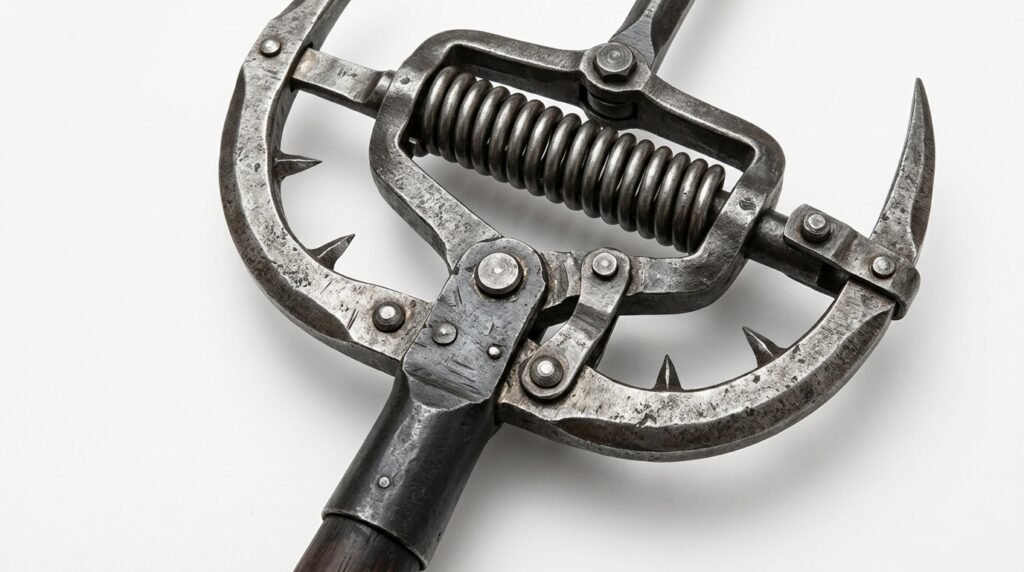
A mancatcher was a pole-mounted restraint weapon. It usually had a long wooden shaft and a metal head shaped like a fork, collar, or semicircular trap. Some versions had hinged parts, inward-facing spikes, or spring-loaded sections that allowed the weapon to close around a person and make escape difficult. Museum examples show that designs varied by country and period, but the basic idea remained the same: the user could keep distance while controlling the target. The Rijksmuseum describes one example as a tool used by city guards to arrest criminals by catching the neck or arm between two blades, with barbs making escape dangerous.
The weapon belonged to the wider family of polearms, but it was different from most battlefield polearms because its goal was restraint. A halberd could cut, hook, or stab. A spear could pierce. This tool was meant to hold. That difference matters because medieval warfare and law enforcement were not always about killing. Capturing someone alive could be useful, profitable, or legally necessary.
The Design of the mancatcher in Medieval Times
The typical design was simple but intimidating. A long shaft gave the user reach. The metal head created a controlled opening. When pushed toward a person, the head could trap part of the body. Some versions had sharp inner points, which discouraged the captured person from struggling or grabbing the pole. Others used hinged mechanisms to close around the target.
| Main Part | Purpose in Use |
|---|---|
| Long wooden pole | Kept the user away from danger |
| Metal collar or fork | Trapped the target’s body or limb |
| Hinged mouth or spring gate | Helped close around the person |
| Barbs or spikes | Made escape risky and painful |
| Strong shaft grip | Allowed pushing, pinning, or dragging |
This design explains why the weapon looked cruel but also practical. It gave guards and soldiers control over someone who might be armed, drunk, violent, mounted, or resisting arrest. The Science Museum Group describes a German example from 1601–1800 as having a heavy spiked metal collar with a hinged mouth on a long wooden pole.
How the mancatcher Was Used on the Battlefield
On the battlefield, the mancatcher was most useful when the goal was to capture rather than kill. In medieval Europe, noble prisoners could be valuable. A captured knight, officer, or wealthy fighter could be held for ransom. Because armor protected the body from many cuts and blows, a restraint pole could be used to hook, trap, or pull a man down without needing to pierce the armor.
One likely battlefield use was against mounted fighters. A soldier on foot could use the long pole to catch part of a rider’s body or armor and pull him from the saddle. Once the rider fell, other soldiers could surround him, remove his weapons, and bind him. This was not easy or safe. A mounted fighter had height, speed, and weapons. Still, in crowded conditions, near gates, in narrow streets, or during a confused melee, a long restraint tool could be effective.
The weapon also helped several men control one person. One guard could trap the target while others moved in. In that sense, it worked less like a single heroic weapon and more like a group-control tool. Its power came from reach, surprise, leverage, and teamwork.
Why Capturing Enemies Alive Mattered
To modern readers, medieval combat is often imagined as endless sword fighting. In reality, status, ransom, and legal authority shaped many violent encounters. Capturing a high-ranking opponent could be more valuable than killing him. Noble families often paid to recover captured relatives. Commanders also wanted prisoners for information, negotiation, or public display.
This made non-lethal control valuable. A weapon that helped stop a person without immediately killing him had a clear purpose. It could protect the captor’s financial interest, preserve a prisoner for questioning, or allow city authorities to avoid unnecessary bloodshed in public spaces. The mancatcher fits into this world because it answered a specific problem: how do you stop a dangerous person while keeping him alive and keeping yourself at a distance?
The mancatcher in Medieval Law Enforcement
Outside warfare, the mancatcher was also connected with policing, prison control, and city guard work. Medieval and early modern towns did not have modern police forces with handcuffs, tasers, radios, or patrol cars. Guards had to manage crowds, arrest offenders, control prisoners, and deal with people who were armed or physically aggressive.
A long pole weapon gave city guards a major advantage. Instead of wrestling with a suspect at close range, they could pin him against a wall, push him to the ground, or hold him long enough for others to help. The Rijksmuseum notes that city guards used such weapons for arresting criminals, especially by catching the neck or arm between the blades.
This use makes the weapon easier to understand. It was not only a strange battlefield device. It was also a tool of authority. It helped turn physical strength into controlled force. A guard did not need to be stronger than the suspect if the pole gave him reach and leverage.
How Guards Controlled Prisoners with the mancatcher
Prisoners presented a serious problem in medieval and early modern settings. Cells were rough, guards were limited, and escape attempts could be violent. A prisoner who refused to move, attacked a guard, or tried to flee needed to be controlled quickly.
In those situations, the mancatcher could be used to pin the prisoner from outside arm’s reach. The guard might press the metal head against the prisoner’s upper body, trap an arm, or force him toward a wall or the floor. The purpose was not comfort. It was compliance. Once restrained, the prisoner could be chained, searched, moved, or locked away.
Because some examples had spikes or barbs, the captured person had a strong reason not to pull away suddenly. This made the tool psychologically powerful as well as physically effective. The sight of it alone may have been enough to stop resistance in some cases.
Was the mancatcher a Non-Lethal Weapon?
The weapon is often described as non-lethal, but that phrase needs care. It was less lethal than a sword thrust or axe blow, but it was not harmless. A spiked iron collar around the neck could injure, cut, choke, or even kill if used violently. If a rider was pulled from a horse, the fall itself could be dangerous. If the target struggled against barbs, serious wounds could follow.
A better description is “capture-focused.” Its main purpose was restraint rather than killing, but it still belonged to a violent world. Medieval tools of control were not gentle. They were designed to make escape difficult and resistance painful.
Different Versions Across Europe
There was no single universal model. Some versions looked like open forks. Others looked like hinged collars. Some were simple, while others had complex locking arms. The details depended on local use, available metalwork, and whether the tool was meant for battlefield capture, guard duty, prison control, or public order.
| Type of Use | Likely Design Feature |
|---|---|
| Battlefield capture | Strong pole, wider catching head |
| City arrests | Barbed or forked head for control |
| Prisoner restraint | Hinged collar or locking mouth |
| Crowd control | Long reach and blunt pushing force |
| Mounted target control | Hooking or trapping shape |
These differences show why the weapon survived beyond the strict medieval period. Some examples in museum collections date from the 1600s and 1700s, showing that the idea remained useful into the early modern world. The Science Museum Group dates one German example to 1601–1800.
The Fear Factor of the mancatcher
The mancatcher worked partly because it looked frightening. A sword was dangerous, but familiar. A pole with a spiked collar at the end sent a different message. It suggested capture, pain, humiliation, and loss of control. For criminals, prisoners, or defeated fighters, that fear could make the weapon more effective.
In medieval society, public authority often relied on visible symbols of force. Guards with polearms, armor, badges, and weapons reminded people that the town or ruler had power. This tool was part of that visual language. It told people that even if they ran, resisted, or fought, there were ways to seize them alive.
Limits of the mancatcher in Real Combat
Despite its usefulness, the mancatcher was not a perfect weapon. It required timing and control. If the user missed, an armed opponent could close the distance. It was also awkward in tight combat unless other guards were nearby. Against multiple attackers, it was less useful than a cutting or thrusting weapon.
It also depended on the target’s position. Catching a moving person was difficult. Holding a strong fighter required leverage and support. That is why the weapon was probably most effective in controlled situations: arrests, guarded spaces, prison yards, gates, streets, or moments when the target was already slowed, cornered, or surrounded.
Why the mancatcher Still Interests People Today
The mancatcher attracts attention today because it challenges the usual idea of medieval weapons. It was not made for dramatic sword duels. It was made for control. That makes it feel strangely modern, because modern law enforcement also uses tools designed to restrain rather than kill.
It also reveals something important about medieval life. Violence was not always random. It was often structured by law, class, money, and authority. Capturing a person could be more useful than killing him. Arresting someone publicly could matter more than defeating him privately. A tool like this shows how practical and calculated medieval force could be.
Conclusion
The mancatcher was a rare but fascinating restraint weapon used in medieval and early modern Europe for capture, arrest, and control. Its long shaft protected the user, while its metal head trapped the target and limited movement. On battlefields, it could help capture valuable enemies alive. In towns and prisons, it gave guards a way to restrain criminals, violent prisoners, and dangerous suspects without immediately resorting to deadly force.